
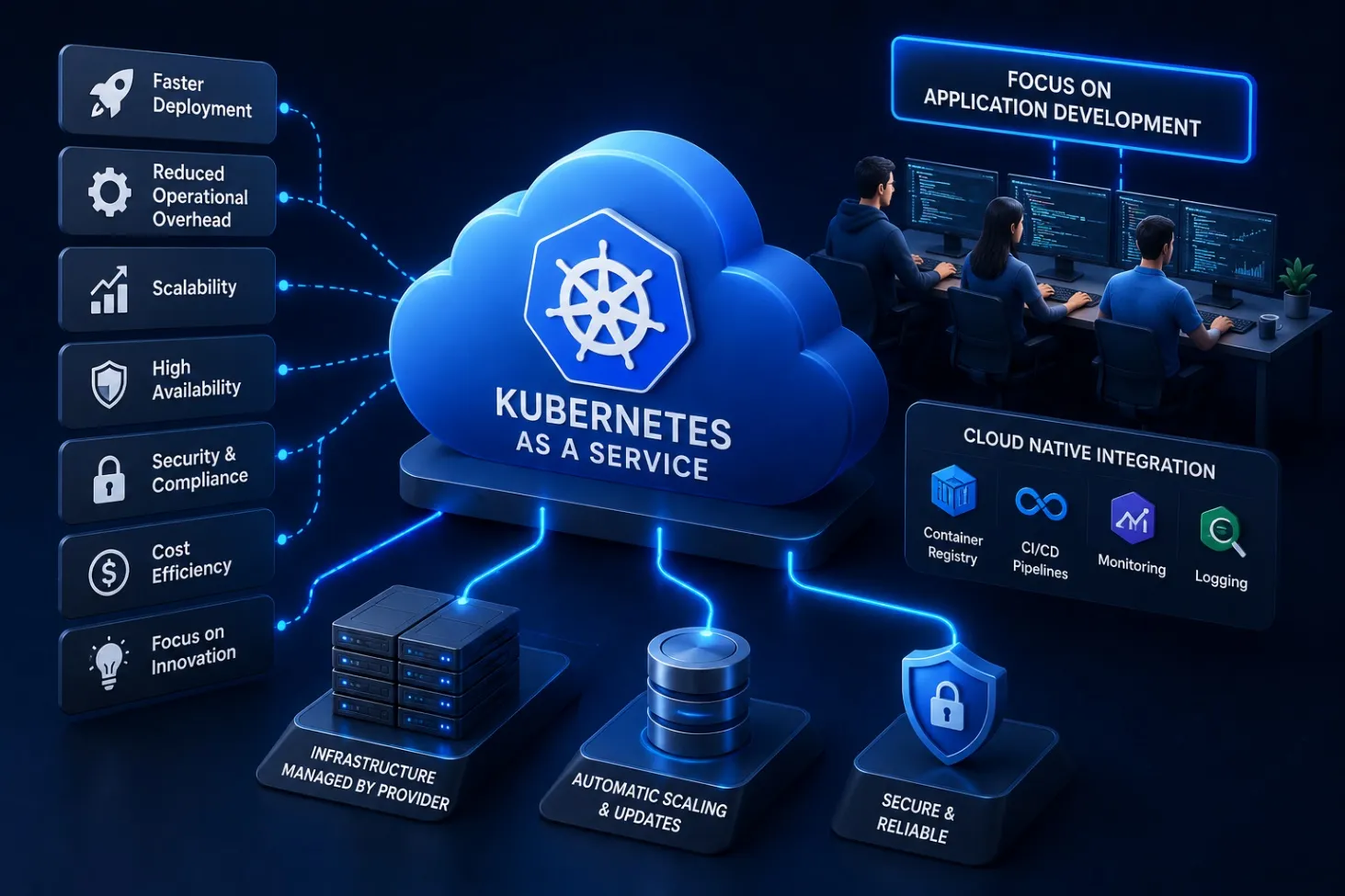
The software development of today is moving towards cloud-native architectures where scalability, automation and reliability is a must. Organizations are adopting microservices and container based deployments, and Kubernetes is becoming the orchestration standard. Managing Kubernetes infrastructure manually can be complex, resource intensive and time consuming.
As a result, many companies are moving towards kubernetes as a service a managed model that simplifies deployment, scaling and operations and allows teams to focus more on application development than infrastructure management.
The Growing Complexity of Managing Kubernetes Manually
Kubernetes is powerful but also complex. Clusters require heavy lifting in expertise to provision, set up networking, manage node pools, orchestrate upgrades, and keep things secure.
That operational overhead can be a burden for many teams. Small configuration errors can cause downtime or performance issues. And the work of DevOps teams is multiplied to maintain high availability in multiple environments.
Managing kubernetes manually is no longer feasible at larger application scales. This complexity is one of the key drivers to move organizations to Kubernetes as a service platform.
What Kubernetes as a Service Actually Means
Kubernetes as a Service (KaaS) is a managed cloud service run by a service provider that manages the underlying infrastructure of Kubernetes. Applications can be deployed on a Kubernetes system right away because there is no need for the team to configure it manually.
The provider handles core things like provisioning clusters, scaling, upgrades, monitoring and security patching.
This enables developers and companies to leverage Kubernetes without managing infrastructure complexity.
Faster Deployment and Reduced Setup Time
Kubernetes as a service has one of the fastest deployment times as one of its biggest advantages. Creating a regular Kubernetes cluster can take hours or days depending on the environment.
Managed service to deploy clusters in a matter of minutes. The developers may immediately proceed to deploying applications without worrying about installation, configuration, and compatibility problems.
The quick onboarding process assists teams to develop their projects and bring them to the market more quickly.
Reduced Operational Overhead for DevOps Teams
Running Kubernetes clusters in-house means constant monitoring, patching and troubleshooting. DevOps teams have to deal with scaling, node failures, networking problems, security patches, etc., as part of their day to day.
In a managed solution, the provider assumes most of these responsibilities. That makes the operations work much easier for the DevOps teams to concentrate on more meaningful tasks such as automation, optimization of CI/CD and tuning the performance.
This enables teams to work more efficiently, and to spend less time maintaining infrastructure.
Built-in Scalability for Growing Applications
Perhaps the most powerful feature of Kubernetes is its ability to scale. But to do that, you need to get your autoscaling policies and resource allocation right.
Scalability is built in the platform with kubernetes as a service. Scaling of applications happens automatically depending on traffic demands without requiring any manual intervention.
That means you can count on performance when traffic spikes, demand ebbs and flows with the seasons or usage suddenly skyrockets. Businesses no longer need to pre-provision resources.
Improved Reliability and High Availability
High availability for self-managed Kubernetes requires careful configuration of multiple clusters, failover systems and redundancy mechanisms.
Reliability is built into managed Kubernetes platforms. These often have inherent fail-over capabilities, auto-recovery, and distributed architecture among many availability zones.
This means that if parts of the applications fail, they will continue to operate, minimizing downtime and improving the user experience.
Enhanced Security and Compliance Support
Security is a big concern for any production environment. Kubernetes security is achieved by regularly patching, configuring access controls, network policies and monitor for vulnerabilities .
Kubernetes as a service means the provider shares or has full responsibility for security. These include automated updates, encryption, identity management, and industry standard compliance.
For organizations that handle sensitive information, it lowers risks and simplifies regulatory compliance.
Cost Efficiency Through Better Resource Management
Managed Kubernetes could be considered to have a higher cost compared to self-hosted Kubernetes. But when you factor in the cost of operations, personnel, risk of downtime and maintenance overhead, the managed model tends to be cheaper.
Teams don’t create extraneous infrastructure and only pay for what they use. Autoscaling based on demand also avoids any waste of compute resources during low demand periods.
That makes kubernetes as a service a financially viable option for many growing organizations.
Better Focus on Application Development
One of the greatest advantages of migrating to a managed Kubernetes platform is having the chance to refocus.
Developers do not have to spend time handling infrastructure but can rather concentrate on coding, developing more features, and improving user experience.
This will increase efficiency and help engineering groups innovate without having the responsibility of operations.
Easier Integration with Cloud-Native Tools
Modern development workflows rely on tooling such as CI/CD pipelines, container registries, monitoring systems and logging platforms.
Kubernetes as a Service platforms are typically built to work well with these tools. It will help in making DevOps process management easier and improve the fluidity of deployment pipelines.
Teams can develop, test and deploy applications in a faster manner without having to go through complicated configurations.
Real-World Use Cases Driving Adoption
There is a trend for many industries to move to kubernetes as a service to improve scalability and reduce operational complexity.
The E-commerce sites use it for managing heavy traffic on sales days. The FinTech firms use it to perform transactions which are secure and scalable. Multi-tenant applications management is done using it by SaaS providers.
The common theme across all of these use cases is the same goal to simplify infrastructure while improving performance and reliability.
Conclusion
Kubernetes as a service is part of a broader trend in cloud computing, one that has focused on reducing complexity and improving efficiency. The proliferation of Kubernetes adoption means that most teams don’t manage infrastructure manually.
Businesses can leverage Managed Kubernetes to achieve faster deployments, better scalability, improved security and less operational burden. And most importantly they liberate teams to innovate, not manage infrastructure.